| Event type: | Meeting |
| Date: | 20th November 2025 |
| Time: | 2:30 pm |
| Venue: | Kenilworth Methodist Church |
| Organiser: | |
| Cost: | Entry is free to u3a members. Non-members are welcome for a nominal charge of £1 |
Speaker: Martin Lloyd
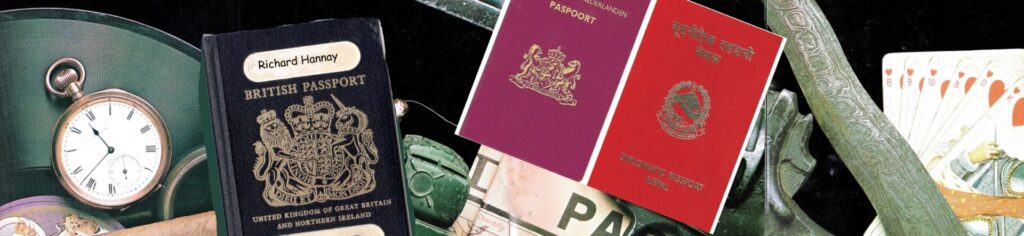
Three passports have played an influential role in the course of history: an attempted assassination, which altered the regulations for issuing passports; the capture of a spy that caused a worldwide modification to the design of the document; and for one person, the passport itself that turned into a killer.
Author and former immigration officer Martin Lloyd has made the study of passports his passion and reveals their role in the course of history in this talk.
Post Meeting Review
Martin’s interesting talk described three events in history that changed the passport system for ever.

The first event was the attempted assassination of Emperor Napoleon III of France. On 14th January 1858 crowds were gathering around the Opera House in Paris as the Emperor and his attractive Spanish wife, the Empress Eugenie, were visiting the Opera House that evening. The Imperial carriage came into sight followed by an escort of Imperial Lancers. As the carriage slowed a man lobbed an object towards the carriage and there was a deafening explosion. This was quickly followed by two more explosions that killed eight people and injured over a hundred. Miraculously the Emperor and Empress were unhurt and were quickly ushered into the Opera House by the Imperial Lancers. The question on everybody’s mind was ‘who could have perpetrated such a murderous plot?’
The answer was Count Felice Orsini, an Italian revolutionary. In the nineteenth century Italy was an amalgam of kingdoms and duchies. Orsini, at an early age, got involved in the struggle for unification and at the age of thirty-five was imprisoned for gun running and sentenced to death. However, Orsini was resourceful and escaped from prison fleeing to Switzerland and then to England arriving in 1856.
Orsini had decided to try and assassinate Napoleon III on the basis that the emperor was an obstacle to Italian unity because he had garrisoned a small detachment of the French army in Rome to uphold the authority of the Pope. Orsini considered that a unified Italy could not be achieved with a foreign army sat in the middle of their country.
Having planned the assassination Orsini needed to return to France however both France and Belgium had strict passport systems with detailed descriptions of the holder. A British passport was considerably simpler with no description of the holder but to travel within France and Belgium a traveller needed these countries passports and neither country would provide a passport for Orsini as he was considered notorious. So Orsini obtained a fake passport which was duly signed off by the French and Belgium consulates. Hence Orsini was able to travel to Brussels and then onto Paris to perform his assassination attempt.
However, after the attempt all the conspirators were caught, including Orsini, after one of them was recognised by the police as a well-known revolutionary. It was subsequently decreed that countries could only provide passports for their own subjects, not subjects of other countries, also the holders’ details would be embedded on all passports.
The second event was when Germany declared war on Russia in August 1914. Immediately the US embassy in Berlin was besieged by hundreds of American citizens demanding the return of their passports they had previously submitted to the German Foreign Ministry to have an exit permit endorsed
One such American was Charles A Inglis who was advised that his passport had been collected the previous day by someone from the United States embassy. This was evidently not the truth.
In August an American named Charles A Inglis registered at an hotel in Edinburgh. His ‘sight-seeing’ took him all over the UK and eventually to Killarney when he was arrested by the Royal Irish Constabulary. He was subsequently searched and apart from his passport, a notebook was found containing notes of British navel movements and addresses in Germany where letters had been sent. These letters had been opened and read by the British Authorities. The man arrested as Charles A Inglis was actually a German called Carl Hans Lody who was subsequently charged with espionage and executed.
This led to the authorities realising that passports should have photos of the bearer though it was some time before the design of the passport and the method of adequately adhering the photo was achieved.
The third event concerned the trial of William Joyce, nicknamed ‘Lord Haw Haw’. In 1945 two British army officers were in a wood near Flensburgh, on the border of Germany and Denmark. Whilst collecting wood for a fire they came across a man who suggested where wood could be found. He spoke in French but realising he was not being understood changed to English. The officers recognised the voice of Lord Haw Haw and arrested him. A search revealed his passport was in the name of William Joyce – the ‘British’ man working as a German radio propaganda broadcaster. Lord Haw Haw had been captured!
Joyce had come to England from America via Ireland at the age of fifteen to continue his education eventually undertaking political activities that brought him to the attention of the authorities.
At his trial it was argued that a passport was not just a travel document, it purported to give the bearer rights and demanded duties in return.

Joyce had lived as if he was British and had renewed his fraudulently obtained British passport by claiming to be British by birth, which was a lie. He had therefore enjoyed the protection of Britain and so he owed allegiance to the British Crown. By broadcasting from Germany, he had betrayed that allegiance and thus had committed treason. He was found guilty and sentenced to death in September 1945.
So the document you carry in order to travel abroad is painstakingly effusive about your nationality and identity but is silent about your required allegiance!!
A very detailed and interesting talk, delivered without notes or graphics, very impressive!