| Event type: | Meeting |
| Date: | 21st March 2024 |
| Venue: | Kenilworth Methodist Church |
A.G.M.
The Kenilworth u3a AGM (Annual General Meeting) will be held before the open meeting at 2.15 pm and will last about 15 mins. All the relevant paperwork – notice of meeting, agenda, minutes of previous meeting and proposals will be circulated to members by email (or by post for those who do not have email) before the meeting. Please do support us by email, post or in person so that we are quorate.
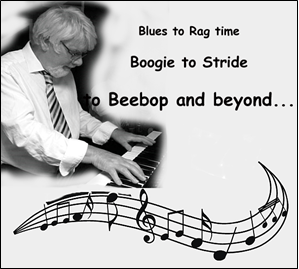
Followed by "The History of Jazz Piano" by Roger Browne

Roger Browne
As a jazz pianist, he has accompanied many top International and UK based jazz artists including George Chisholm, Humphrey Lyttleton, George Melly, Marion Montgomery, Stefan Grappelli, Louis Armstrong all-star, Bud Freeman, Scott Hamilton, Danny Moss etc. He has played in many countries and across the UK, America’s West Coast, in California and Washington State, in Montana, Arizona, Canada’s British Columbia, across the Caribbean, in Spain, Germany, Norway, Republic of Ireland and The Netherlands. Roger, now, apart from playing piano for Manchester Jazz and various of his own groups, delivers talks about his amazing life of music, featuring stories, songs, and interpretations of music by Gershwin, Kern, Porter etc., in his own inimitable piano style.
Our Open Meeting in March had an exceptional musician and speaker. Roger Browne captivated us with his jazz interpretations on his pianoforte interspersed with his stories about the early development of jazz in America.
Roger has many talents. He was an actor and is a singer, speaker, musician, director, composer, writer and jazz pianist. He demonstrated his remarkable talents as a jazz pianist but also as a gifted speaker.
Roger got immersed into music at the young age of eight when he won a prize at a public singing competition. On receiving his prize of a bottle of Toni Hair Perm he decided that he could aspire to greater heights by following jazz with his pianoforte.
At the beginning of the last century in New Orleans, jazz was in its infancy and was being created by a cocktail of different musical enthusiasts who were immigrants from a number of different countries.
Roger told the tale of Fats Waller, the American jazz pianist, who was kidnapped in Chicago in 1926. Four men bundled him into a car, blindfolded him and took him to a party organised by the gangster Al Capone. With a gun in his back he was pushed towards a piano and told to play. Different mobsters demanded Fats play different tunes, thankfully after each rendition he was very well rewarded with dollar bills stuffed into all his pockets.
Roger also described the initial problems of the infamous Cole Porter who was trying to get his work published in Tin Pan Alley – New York’s music publishing district. The area was in the Jewish quarter and it was only when he was advised to make his music sound more Jewish that his luck changed and his work was accepted.
Roger relayed many stories about the early days of jazz in America and demonstrated his incredible skill on the pianoforte. Not at all bad for someone who has not had any musical training and to this day cannot read music.
A truly remarkable musical afternoon for a very large audience who really enjoyed the music and anecdotes from Roger Browne.
Postscript to Roger Browne’s musical talk – comments by David Roots – Ku3a Jazz Appreciation Group convener
Having started his talk with some humorous anecdotes about his past, Roger deftly segued onto the subject in hand and described how jazz slowly developed before settling down to talking about the piano in jazz. Alas, his allotted time was not long enough to fully develop the history, but he did manage to cover the earliest elements, notably ragtime and stride, before demonstrating how the music came to influence the development of the more widely known sides of popular music, notably musical stage and the dissemination of sheet music.
Roger’s anecdote about Arthur Rubenstein’s attempt to copy an Art Tatum piece, only to be upstaged by Art’s subsequent version of the same tune, only goes to show the true nature of the music. That nature is the art of improvisation which means that no two performances of the same tune are ever exactly the same. It also demonstrates the need for a successful jazz piano player (or any other instrument) to be as equally skilled as a classical player but in a different manner.
If your interest in jazz was aroused by what you heard, the u3a Jazz Appreciation group would love to hear from you. Please take the opportunity to visit the u3a website and select Jazz from the groups heading. Here you will find all about our latest position, which is dormant but seeking new members.
You will also find links on the website to two pages:
“What is Jazz?” This is a brief page to answer the age-old question.
“A Short History of Jazz Part 1” This link takes you to a piece that I have written for the benefit of newcomers to the music and includes a playlist together with a link to that playlist on Spotify.
Please note: It is not necessary to subscribe to Spotify as there is a free version however every so often you will have to listen to an advert.
You can also contact me by email by clicking the link this link: David Roots
David Roots