| Event type: | Meeting |
| Date: | 18th July 2024 |
| Venue: | Kenilworth Methodist Church |
| Organiser: | |
| Cost: | Entry is free to members (non-members welcome for a £1 donation) |
Speaker: Adrian James
Folklore and More. Adrian has previously given a talk at our Open Meeting – ‘Gardens of Paradise’. It was very well received so we are delighted he has agreed to join us again.

From the snowdrop in January, allegedly given to Eve by an angel to symbolise hope, to evergreens used at Christmas to deck the halls, you will learn many curious facts about some of our common flora. The Foliate Head or Green Man, is one of the earliest elements in paganism, yet is used in church and cathedral decoration around the country. Each year in Shropshire the Battle of Spring and Winter is re-enacted, and the Ice Queen is always defeated by the Green Man and Gaia the goddess of the harvest!
Adrian James
"I have been photographing gardens and plants on a freelance basis for many years. I distribute my work through the specialist horticultural image library GAP Photos . I am also happy to undertake commissioned garden photography, so please do get in touch if you would like to discuss a commission. With interests in garden history and in that rather esoteric topic of what gardens are actually for, combined with a strong sense of connection to these spaces, I also use my images in a range of garden talks which feature gardens from many parts the world and where possible using gardens that people may not know well. I also have a passion for travel, often to places somewhat off the well beaten track and always with a camera in my hands, and I offer a number of travelogue style talks too. Based in the picturesque village of Offenham near Evesham in Worcestershire, with my other hat on I am the under-gardener at Langdale Garden , which my wife Sheila & I have developed since moving to Offenham in 2009".
A Review of this excellent Talk
Adrian is a freelance photographer and gardener, he has previously spoken to us about ‘The Gardens of Paradise’, a fascinating talk about creating gardens in desert like areas of the world. This time his talk was about the stories and folklore associated with plants, trees and seasonal festivities throughout the year, some of which have been detailed below:

The flowering of snowdrops or milk flower is one of the first signs that winter is drawing to an end. As a result, the flower has long been viewed as a symbol of hope for better times ahead. However, to see a single snowdrop flower is a sign of impending death, probably due to its shape being like a shroud. It was also considered bad luck to take the flower into a house.
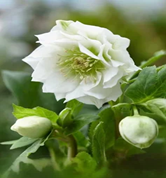
A charming myth surrounding the Christmas rose concerns a story about a young shepherdess called Madelon. Legend has it that she was tending her flock one cold night and saw the three wise men of the Nativity pass by carrying gifts to the baby Jesus. Madelon wept because she had nothing to give. However, as her tears fell to the ground an angel parted the snow to reveal a plant with beautiful white flowers – a Christmas rose – and the perfect gift.

There are two distinct variations of wassailing which was usually held on twelfth night, but now between late December and February. One involves groups of merrymakers going from one house to another, wassailing bowl in hand, singing traditional songs and generally spreading fun and good wishes – early carol singing? The other form of wassailing is generally practiced in the countryside, particularly in fruit growing regions, where it is the trees that are blessed in order to get a good harvest. A very noisy shindig involving Morris dancing and occasionally twelve bore shotguns!!
The Hawthorn tree has white blossom and red berries which are much loved by birds. The trees often grow in quite wild places with the belief that fairies live in the top branches. A special form of Hawthorn tree that flowers twice a year grows near Glastonbury. A small branch of this tree is sent to the monarch each Christmas to decorate his breakfast table.


The Green Man is depicted by a green face or head with foliage growing from it. Often seen on pub signs and depicted in churches and cathedrals. A bit of an enigma but usually associated with the May Day celebrations when the Green Man and Ice Queen do battle, with the former always winning, to celebrate Spring
According to folklore, when the devil was cast out of heaven by Saint Michael, he landed on a bramble / blackberry bush and cursed it by spitting on it (and worse! ).It was believed this caused blackberries to become less palatable around 29 September – St Michael’s Day- after which they should not be picked


Holly, Ivy and other greenery were used during winter solstice celebrations to ward off evil spirits and celebrate new growth. In pagan times, Holly was thought to be the male plant and Ivy the female. So, if a wreath was placed on the front door, it was thought that the quantity of Holly or Ivy dictated who ruled in the house over the next year! You might not see them much nowadays but cabbages were previously used for Christmas decoration!
A very interesting talk by a gardener who obviously knows his flora and fauna, much appreciated by a large audience.